
Present & Accounted For: Attendance Strategies with a Plot Twist


Sometimes our lives can feel like a TV show. There’s even those surreal moments when we see our own plotlines and daily struggles perfectly captured on the screen in our living rooms.
That’s exactly the energy Fenicia Jacks, Manager- Attendance and Truancy, Student and Family Services at San Francisco Unified School District, brought to our recent live session. She shared how she frames attendance improvement strategies and helped us think about how we would apply them in a fun, interactive session featuring clips from Abbott Elementary.
In case you missed the live broadcast, or just want a refresh, we’re recapping the major takeaways below.
Viewing Attendance Improvement Through the 7-Circle Model Lens
When tackling any problem, it's easy to focus on surface-level symptoms. But just like with our own wellness, addressing unhealthy attendance requires a holistic, root cause approach.
Fenicia shared how she approaches attendance improvement with the 6-Circle Model, an organizational diagnostic tool. With three circles above a green line being the technical components of a system (pattern, structure, process) and three circles below the line representing the relational aspects of a system (relationships, identity, and information). In the context of attendance improvement, oftentimes these technical aspects are mandated by law, and the relational aspects are additional best practices that educators weave into their work.
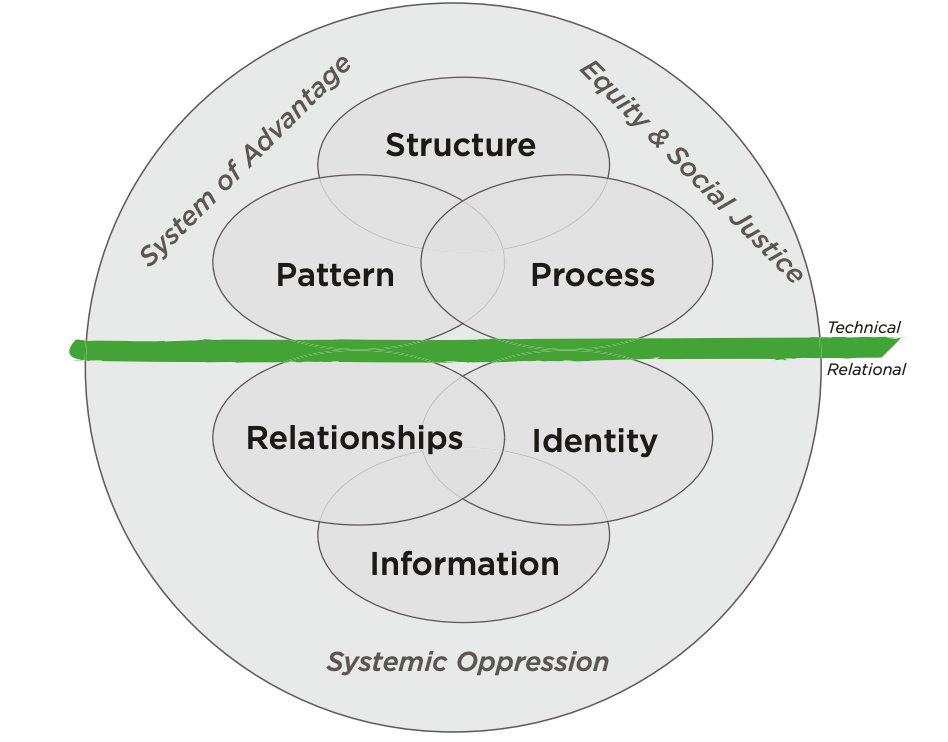
Surrounding these six circles is a seventh circle, the lens of systemic oppression, that speaks to the different ways that students of different backgrounds may be experiencing the world and all of its injustices, and how that may be contributing to their absenteeism.
By using this framework, we can consider attendance strategies across the technical and relational categories, and remain mindful of the unique contexts that every student holds when employing any particular attendance strategy. Sometimes attendance strategies may be universal, and other times different strategies are more high-impact for different students.
So, how does that look in real life, and in TV portrayals?
Attendance Strategies: Seen (and Unseen) On TV
1. Does Everyone Actually Know the Attendance Policy?
In the episode we explored, we saw a bright student, Alex, with great attendance in the prior year, suddenly have an alarming amount of unexplained absences. His teachers were concerned, but also unsure about the district’s attendance policy and what to do next.
It sounds basic, but you might be surprised by the disconnect in your own buildings. Staff members don't always know the exact attendance and truancy protocols, and school-family communication channels aren’t always clearly defined.
Before we can expect families to follow the rules, we have to ensure our internal teams are aligned and that communication flows both ways across accessible channels. Within our live session, we discussed the importance of everyone within the school and district understanding the attendance policy and the protocol to spring into quick action and address absenteeism.
2. Does Everyone Know How Much School They’re Missing?
Absences have a way of creeping up on both families and school staff. This was illustrated in the Abbott Elementary clip as Alex’s absences seemed to creep up on both his family and staff members.
The EveryDay Labs intervention was designed with this very fact in mind, as families often underestimate their student’s absences by a factor of 2. It’s why our mail and text nudges are clearly written and personalized with a student’s actual absences, helping families understand exactly how much was missed and gently bringing the reality of missed instructional time to light.
3. Meeting Students and Families Where They Are: Literally and Figuratively
As acknowledged in the 7 Circle Model, students are coming into school with different family situations, challenges, and expectations. It’s why when done right, home visits can be a proactive way to better understand the student’s background and build trust before a crisis occurs.
In the Abbott Elementary clip, Alex lived with his elderly grandmother who was hard of hearing. His concerned educators made a home visit to get a better understanding of what was going on, and to better emphasize the importance of attending school.
They learned that his grandmother didn’t want to push him to attend school when he didn’t want to, and mentioned that back in her day, people didn’t necessarily go to school every day, but when they could. And Alex was perfectly happy to stay home and watch The Price is Right with his grandmother. Here was where his educators figuratively met him where he was, showing him how every day at school connects directly to achieving their personal goals. Even if his goal is simply to be on The Price is Right, showing up as a fierce competitor requires strong attendance in math and gym class.
The live session attendees discussed the importance of helping families coming in from different generations and backgrounds understand the importance of attendance and communicating with their school when students are absent to avoid escalation into truancy court.
Directing the Next Episode
As we all know too well, improving attendance isn't a one-size-fits-all script. By balancing the technical, mandated components of attendance work with the deep relational work that builds trust, we can rewrite so many narratives around chronic absenteeism.
Looking for a partner to help nurture family-school partnerships and staff capacity for better attendance? EveryDay Labs can help!
Explore Our Latest Insights
Stay informed with our recent blog updates.

Now Sending: Email on the EveryDay Platform
You may already know that you can set up text messages and physical mail to go out to your district’s families directly from the EveryDay Labs platform. But did you know that we’ve added a powerful new layer to our communication ecosystem? Now, you can seamlessly connect with families via email, right from the EveryDay Platform’s multi-channel communications hub. Read on for the details!

EveryDay Labs vs. Apptegy Attendance Pro
When so many students are facing chronic absenteeism, a proactive approach, built on immediate communication and actionable insights, will get more students back on track for success. Two solutions that support districts in this proactive attendance work are EveryDay Labs and Apptegy Attendance Pro. Both platforms aim to reduce student absenteeism and simplify the lives of the educators they serve, but their approaches have some similarities and differences. In this post, we break down their shared core capabilities and the areas where they diverge to help guide your decision as you choose a partner in improving chronic absenteeism.
Join Our Community of Learners
Stay updated with our latest insights and share your thoughts with fellow educators and parents.
